

Brand Strategy: The foundation everything else is built on
A brand strategy defines what a brand stands for, who it’s relevant to, and how it’s managed across every area. But that alone isn’t enough. A brand strategy is only strong once it doesn’t just exist on paper — but once teams, partners, and leaders actually make different decisions because of it. That’s why, at CRENEO, we always develop brand strategy as a service as a rulebook: directly applicable, with no room for interpretation, and as the foundation for corporate design, website, and brand portal.

What is a brand strategy?
A brand strategy is a structured rulebook that defines what a brand stands for, who it wants to reach, how it differs from the competition, and which principles apply to every decision made about the brand. It classically includes positioning, brand core, target audiences, brand architecture, and communication principles.
For CRENEO, a brand strategy goes one step further: it isn’t the result of a workshop that gathers dust afterward. It’s the decision-making foundation that internal teams, external partners, and new employees can refer to every day — without having to ask the agency each time. A good brand strategy makes a brand manageable.
Why many brand strategies fail in practice
Many organizations have a brand strategy — at least on paper. The real problems don’t arise in the workshop, but afterward.
Typical signs:
- Nobody can say clearly anymore what the brand truly stands for.
- Every unit communicates its own version of the brand.
- Strategic decisions end in compromise because the foundation is missing.
- Corporate design and website pull in different directions.
- New employees, external partners, or AI tools create additional inconsistency.
- The same discussion starts over again at the next relaunch.
The problem is rarely that the strategy was wrong. The problem is that it wasn’t formulated in a way others can actually work with. A brand strategy that only lives in a workshop document isn’t a strategy — it’s a snapshot.
What CRENEO develops in a brand strategy
We develop brand strategy as a system of four building blocks. Each one is formulated so it can flow directly into corporate design, website, brand portal, and communication — without a new briefing, without room for interpretation.
Positioning
What the brand stands for — and what it doesn’t. Through qualitative and quantitative competitive analyses, we clarify what the organization can credibly own, which target audiences should be reached, and where the real gap in the market lies. The result isn’t wishful thinking — it’s a decision.
Brand identity and brand core
What the brand is as a personality, as a promise, as an attitude. Values, character, and brand core are developed so they’re not just documented — but so teams actually make different decisions afterward. A brand core nobody can recall in everyday work is worthless.
Brand architecture
How the brand relates to sub-brands, product brands, or subsidiaries. Who’s allowed to appear under which umbrella, and how — and who isn’t. Clear brand architecture replaces 30 variations with binding rules. Especially relevant for organizations with multiple units, locations, or brands under one roof.
Brand communication and brand voice
How the brand presents itself — visually and verbally. Tone, corporate voice, language rules, imagery. Not as an appendix to a style guide, but as a brand voice that’s directly applicable — for internal teams, external partners, and AI-assisted communication.
Brand strategy as a rulebook — not a document
The decisive difference between a brand strategy that works and one that fails isn’t the content — it’s the form. A strategy PDF that nobody opens again after the workshop changes nothing. A rulebook that flows directly into brand portal, corporate design, and website changes how an organization works with its brand every day.
At CRENEO, we don’t hand over a presentation. We hand over:
- a formulated positioning that functions as a decision-making foundation
- a brand core everyone on the team can explain
- clear architecture rules for all units and sub-brands
- communication principles that can be translated directly into copy, campaigns, and AI prompts
- training for the internal team, so the strategy doesn’t end up in a drawer
This turns a brand strategy into a system that works without us.
Which methods are part of a brand strategy?
Depending on the starting point, we use different tools. What matters to us isn’t the model itself, but what insights it produces and whether they lead to clear decisions.
Brand workshop
The brand workshop is the core of every strategy process. It brings the right people together, clarifies the starting point and goal, and creates the foundation for every step that follows. A workshop alone, however, isn’t yet a strategy — what matters is what gets formulated, decided, and handed over afterward.
Qualitative and quantitative competitive analysis
Before we formulate anything, we look at what the market already occupies — visually, verbally, and strategically. This way, positioning doesn’t come from gut feeling, but from a well-founded assessment of what’s credible and differentiating.
Target audience and stakeholder analysis
Especially for complex organizations, a simple target audience description isn’t enough. What matters is which stakeholders work with the brand, evaluate it, approve it, or apply it in everyday work — both internally and externally.
Brand architecture analysis
For organizations with multiple units, sub-brands, or product brands, we clarify which architecture — branded house, house of brands, or endorsed brand — fits the strategy and is viable long term.
Brand core development
The brand core is the content center of the brand. We develop it so it functions as a decision filter: what fits the brand — and what doesn’t?
When does a brand strategy make sense?
A brand strategy is especially useful when an organization has grown — but the brand is no longer clearly managed. This moment often arises through new structures, new teams, mergers, or a planned relaunch.
Typische Auslöser:
- The brand comes across differently across different areas.
- Strategic decisions are regularly postponed or resolved as compromises.
- A corporate design relaunch or website relaunch is coming up.
- Multiple units, locations, or external partners work with the brand.
- New leadership needs a clear, shared foundation.
- AI, templates, or external service providers create new variations without shared direction.
- After growth, a merger, or a repositioning, the brand needs a new strategic foundation.
What should result from a brand strategy
A brand strategy shouldn’t stop at a description. What matters is what happens afterward. In our view, a good brand strategy needs a clear outcome: formulated so it’s understandable, directly applicable, and a foundation for everything that comes after.
Possible outcomes:
- a formulated positioning as a strategic rulebook
- a defined brand core everyone on the team can recall
- clear brand architecture for all units and sub-brands
- communication principles and brand voice
- requirements for corporate design, website, and brand portal
- a roadmap for relaunch, rebranding, or systematization
This turns the brand strategy from a theoretical document into the foundation everything else is built on.
Examples from practice
Brand strategy becomes especially relevant when brands need to function within complex structures: in corporate groups, social organizations, regulated industries, or growing B2B companies. In such contexts, a clearly defined visual identity isn’t enough. What matters is whether the strategy can be reliably applied by many people.
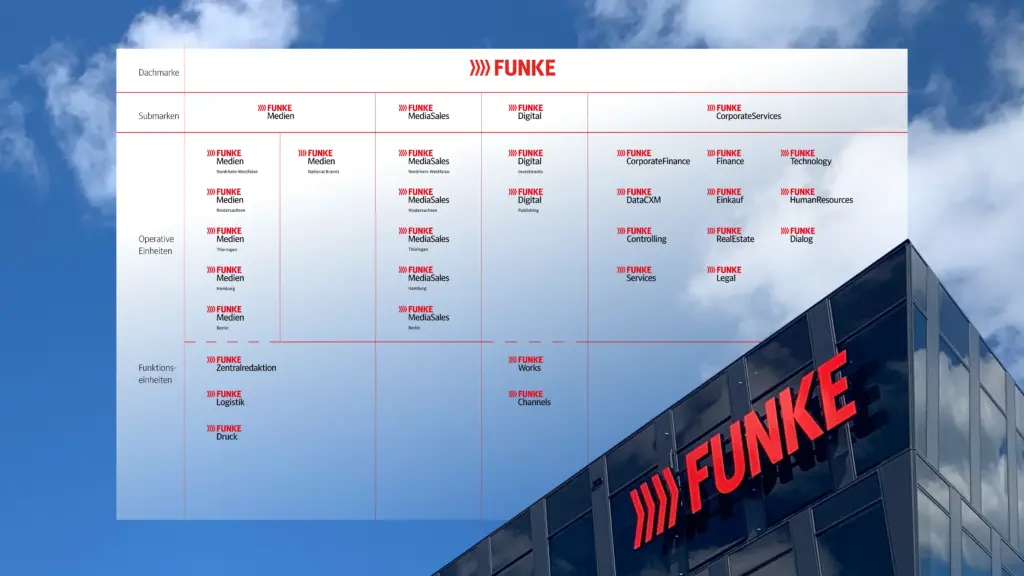
FUNKE Media Group — Brand strategy and brand architecture for over 30 sub-brands.
Learn more

Wesselmann Werbung — Repositioning, four value dimensions, a complete brand system.
Learn more

AWO Mittelrhein — Brand workshop, values, goals, and tone defined together.
Learn more
Frequently asked questions about brand strategy
A brand strategy is a structured rulebook that defines what a brand stands for, who it wants to reach, and how it’s managed across every area. It includes positioning, brand core, brand architecture, and communication principles — as the decision-making foundation for everyone who works with the brand every day.
Brand strategy defines what a brand stands for in terms of content — positioning, values, architecture, communication principles. Corporate design translates that strategy into a visual system of logo, colors, typography, and imagery. Without a brand strategy as the foundation, the same discussion repeats itself at the next relaunch.
Brand strategy defines the brand’s identity, positioning, and principles — long-term and fundamental. Marketing strategy builds on that and defines how the brand is communicated in specific campaigns and channels. Without a brand strategy, the marketing strategy lacks direction.
Especially when an organization has grown but the brand is no longer clearly managed — due to new units, new leadership, a planned relaunch, or growing inconsistency in everyday application. A clear brand strategy is also the most sensible prerequisite before a corporate design process or website relaunch.
Depending on the starting point and complexity, a brand strategy process at CRENEO typically takes 6 to 12 weeks — from analysis through the brand workshop to handover as a directly usable rulebook. Positioning and brand core alone are often developed in 4 to 6 weeks.
You want to develop a brand strategy that holds up after handover?
For us, a brand strategy isn’t a workshop outcome. It’s the foundation everything else is built on — internally, externally, today and in two years. When positioning, brand core, architecture, and communication no longer work together cleanly, every decision becomes a discussion. A structured strategy process turns this into a rulebook that works without us.
Let’s talk — before unclear direction becomes a systemic problem
Many brands don’t lose their clarity suddenly — they lose it gradually. Through growth, new teams, new demands. At some point, decisions become harder, communication grows less consistent, and nobody can say anymore what the brand actually is.
Let’s look together at where your brand stands today — and what it needs to become clearer, more consistent, and easier to apply again.