Brand portals: The central platform for brand management
Many organizations have a brand strategy and a corporate design. But when external partners work with outdated assets, internal teams search for CI guidelines as a PDF, and no one knows which logo version is the current one — that’s when the missing link between strategy and everyday work becomes clear. A brand portal can be the right solution.
A brand portal is that missing link. At CRENEO, it isn’t built as a technical tool, but as the logical final step of the brand system — the platform where everything comes together and from which everyone can work independently.
What is a brand portal?
A brand portal is a central digital platform where all of an organization’s brand rules, assets, and communication materials are bundled, made accessible, and maintained. It replaces scattered PDF documents, unmanaged Dropbox folders, and endless email requests with a single source of truth.
A brand portal typically includes corporate design guidelines, logos, and assets in all variants, templates for internal and external communication, approval processes and roles, and rules for applying the brand voice — all in one place, always up to date, and accessible to everyone who needs to work with it.
Brand portal, DAM, or guidelines PDF — what’s the difference?
This is one of the most common questions — and the answer matters, because many organizations invest in the wrong tool.
Guidelines-PDF
A static document explaining what the brand should look like. It’s created once, rarely updated, and even more rarely used. There’s no way to download assets directly, manage approvals, or check whether the rules are being followed.
DAM — Digital Asset Management
A system for managing digital files — images, videos, documents. A DAM stores and organizes assets but doesn’t explain how they should be applied. It lacks the strategic framework: why these assets exist, who is allowed to use them and how, and what counts as correct brand application.
Brand portal
The combination of both — plus governance. A brand portal connects rules, assets, and processes into a system that teams can use independently. It’s not just a storage location, but a living resource that operationalizes brand management.
Why brand management without a portal becomes a bottleneck
Developing a corporate design is one thing. Making it work in the organization on an ongoing basis is another. Without a central brand portal, the same problems keep recurring.
Typical signs:
- CI guidelines exist only as PDFs that nobody opens.
- Assets are outdated, hard to find, or used in the wrong versions.
- External partners, agencies, or new locations keep asking for current files.
- Every approval runs through the same two people — because it’s unclear who else is allowed to decide.
- After a rebrand, outdated logos are still circulating months later.
This isn’t a communication problem. It’s a system problem — and it can be solved once brand management gets a central platform that everyone involved can use independently.
How CRENEO develops a brand portal
At CRENEO, a brand portal isn’t a technical project that starts in isolation. It’s the logical next step after brand strategy and corporate design — because a portal only works if the foundation is right.
Three decisions are decisive here:
Brand portal as a handover tool
CRENEO’s handover promise doesn’t end with the presentation of the final designs. It ends when the internal team can work independently with the brand. A brand portal is the tool that operationalizes this handover — with rules, assets, templates, and training all in one place.
Governance as part of the system
A brand portal without governance is just a well-organized folder. What matters is who has which rights, who grants approvals, and how it’s ensured that only current and correct content is used. That’s why we develop roles, approval processes, and access structures as a fixed part of every portal.
Scalability from day one
A brand portal built for ten users that breaks down at a hundred isn’t a system. That’s why we design portals to grow with the organization — new units, new locations, new languages — without the portal having to be rebuilt.
When isn’t this the right step?
This is a question we answer honestly — because a brand portal doesn’t make sense for every organization.
A brand portal makes sense when many people work with the brand — internally, externally, across locations. If an organization is small, has few external partners, and the brand is managed centrally by one person, a well-structured guidelines document with an organized file storage system is often enough.
The right moment for a brand portal is when coordinating around the brand takes more time than the actual brand work itself — or when a rebrand is coming up and it needs to be ensured that outdated content truly disappears.
What a brand portal at CRENEO includes
A brand portal is always the interplay of several building blocks. Only in combination do they create a platform that truly operationalizes brand management.
Corporate design guidelines
All the brand’s rules — colors, typography, logo, imagery, application examples — accessible, searchable, and always up to date.
Asset library
Logos, icons, templates, images — in all variants and formats, with clear usage rules and approval status.
Templates & communication materials
Reusable templates for all relevant communication situations — built so teams can adapt them independently without compromising the brand.
Roles & governance
Who can download what, who grants approval, who maintains the content. Clear structures that make brand management scalable.
Brand voice & corporate voice
Tone, vocabulary, phrasing principles — anchored directly in the portal, so external copywriters and AI tools work within the right framework too.
Onboarding & training
A brand portal is only as good as its adoption. That’s why introducing it to the internal team is a fixed part of the process — so the portal doesn’t go unused.
In practice
Two organizations. Two different starting situations. One shared requirement: brand management that works without constant agency involvement.
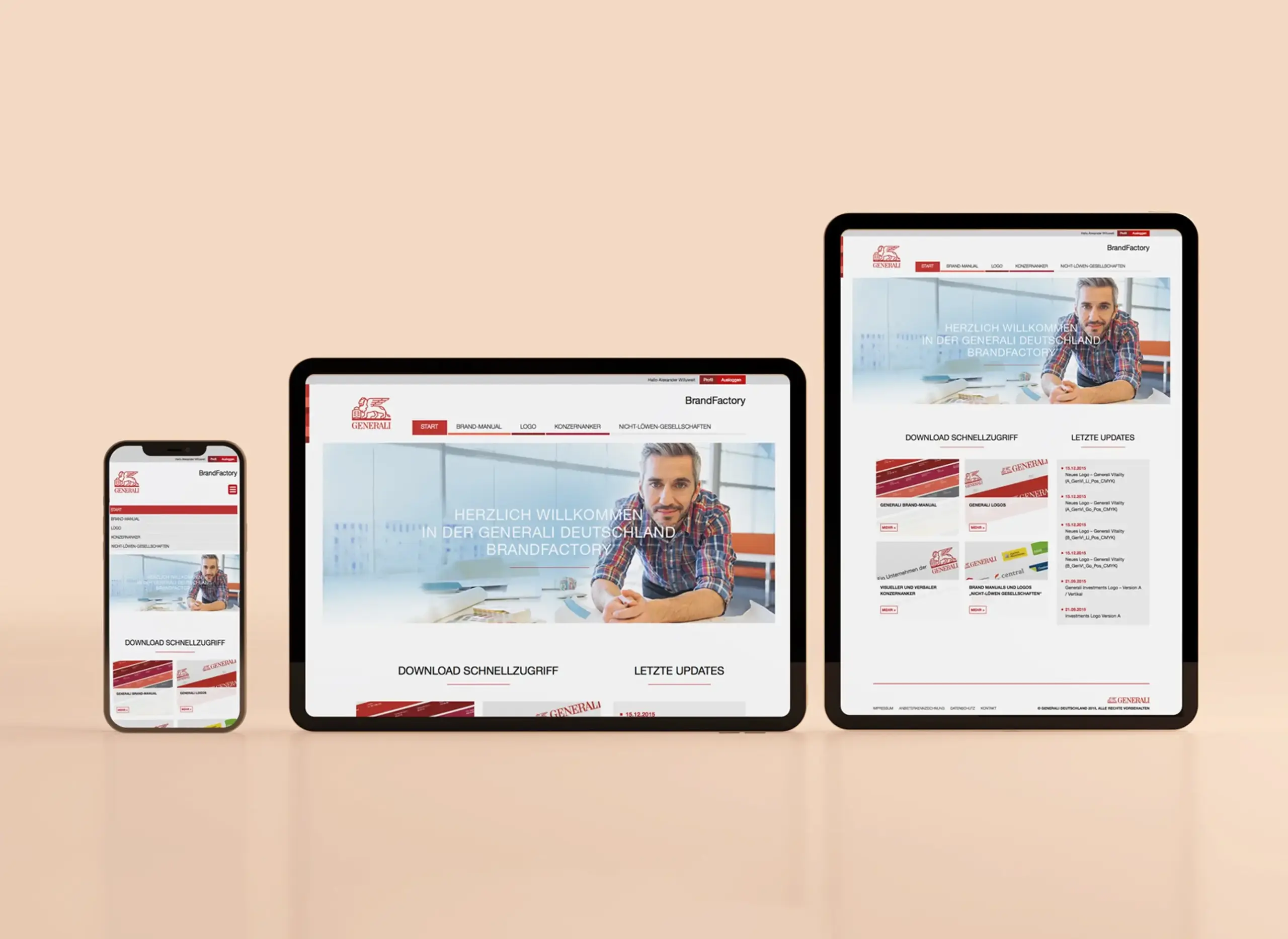
Generali Germany — Brand portal for a regulated financial services provider.
Learn more
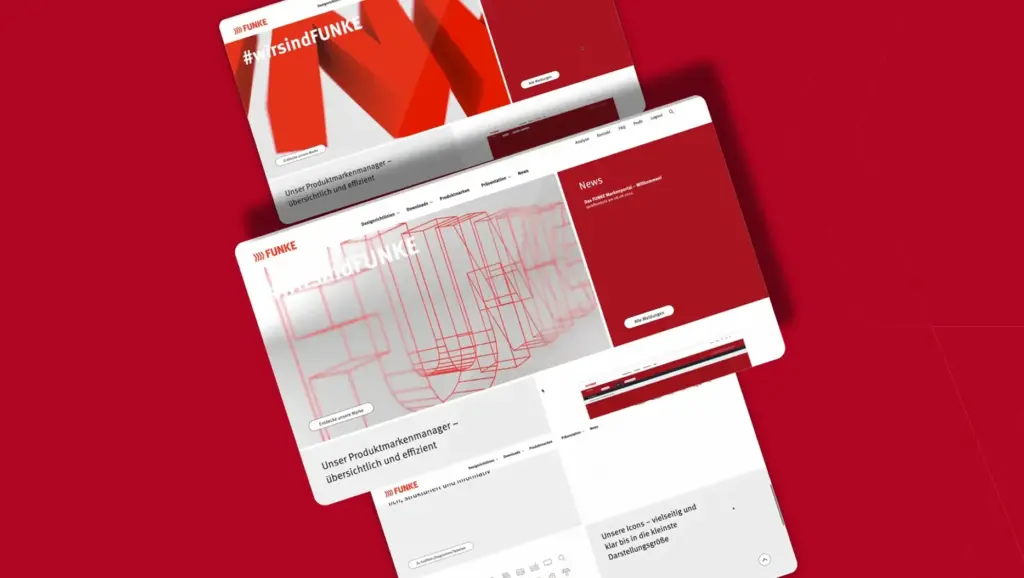
FUNKE Media Group — Brand portal for 30+ sub-brands and 6,000 employees.
Learn more
Häufige Fragen zum Markenportal
A brand portal is a central digital platform where all of an organization’s brand rules, assets, and communication materials are bundled and made accessible. It replaces scattered PDFs and unmanaged file folders with a single, current source — for everyone who works with the brand every day.
A DAM — Digital Asset Management — manages digital files. A brand portal goes further: it connects assets with rules, governance, and processes. A DAM tells you where a file is located. A brand portal tells you how it may be used — and who gets to decide that.
A brand portal makes sense when many people work with the brand internally and externally, when coordinating around the brand takes more time than the actual brand work, when a rebrand is coming up, or when external partners, new locations, or AI tools communicate with the brand without a shared framework.
Costs depend on scope, complexity, and requirements — number of users, governance structures, integrations, and automations are typical cost drivers. What matters isn’t just the development budget, but whether the portal can be maintained independently afterward. If you’d like to know what a brand portal would mean for your specific situation, talk to us directly.
The timeline depends on the starting point and scope. A Portal Starter — with a core set of rules, templates, and structure — can be realized significantly faster than a full portal with automations and complex governance. Our Portal Starter is a compact first step in that direction.
A brand portal that actually works in your organization
A brand portal isn’t finished when it goes live — it’s finished once everyone who works with the brand every day can use it independently.
When coordinating around the brand becomes a bottleneck, external partners work with outdated assets, or a rebrand is coming up and you need to make sure outdated content truly disappears — that’s exactly the moment worth looking at together.
Alexander Willuweit takes 30 minutes to understand your starting point and find the most sensible next step together. No pitch. No pressure. A real conversation.