Brand Portal Agency — Brand Management for Everyone Working With the Brand Every Day
When the brand is supposed to be managed — but only the marketing team knows where everything is.
A corporate design exists. Guidelines too. The problem is that neither reaches the people who work with the brand every day. As a brand portal agency, we close that gap — by developing a system that does not simply manage your brand, but makes it manageable.
Many brands. Decentralized teams. One platform for everyone.
Regulated market. High compliance pressure. A portal that creates security.
What happens when no brand portal exists
External partners work with outdated versions
Logos, colors, typography — everything is scattered across different places. Anyone without direct access to the marketing team simply uses whatever they can find. The result: twelve different versions of the brand out in the world.
Brand guidelines exist — but nobody reads them
The guidelines are there — as an 80-page PDF. Hardly anyone reads it completely. So when someone needs the brand color for a presentation, they google it instead. Not out of carelessness, but because there is no better alternative.
Approval processes run via email and take forever
Every campaign, every presentation — someone has to check whether it is on-brand. The marketing team becomes both guardian and bottleneck at the same time. The more business units exist, the bigger the bottleneck becomes.
Onboarding takes weeks instead of hours
New employees, new agencies, new locations — the same effort every time. Where is the latest template? Which logo is approved for external use? Who needs to ask whom? A system solves these questions once — instead of solving them again and again.
The problem is not the corporate design.
The problem is that there is no system bringing it into the organization.
A corporate design explains the brand. It does not manage it. A brand portal closes that gap — but only if the brand system behind it exists. At our agency, we never develop a brand portal in isolation: strategy, corporate design and portal are conceived as one connected system.
01
Analysis & Structure
Which assets exist, which rules apply and which teams need what? Before we build anything, we define together in a workshop what the portal actually needs to do — for whom, in which contexts and with which governance structure. We also assess which existing systems should be connected immediately or later on.
02
Architecture & Content
We structure and develop the brand portal so that it is usable — not just complete. In practice, that means navigation, access rights, content structure and content types. The architecture is designed to grow with your organization: new business units, new markets and new content types can be integrated without rebuilding the system. Because the system needs to work without explanation.
03
Design & Implementation
The portal follows the brand system — not the other way around. That is why we build on the existing corporate design, develop the technical platform, integrate existing tools and implement automations wherever it makes sense to solve recurring tasks directly within the system.
04
Handover & Operations
At the end, the marketing team takes over independently, making updates possible without relying on us as a permanent service provider. To ensure this works smoothly, we carefully document and train teams — and continue supporting the organization wherever assistance in day-to-day operations is desired.
What changes — in practical terms
Without a brand portal
- Assets are scattered — everyone finds something different
- External partners work with outdated files
- Approval processes run through email and slow everything down
- New business units require onboarding every single time
- The marketing team becomes a bottleneck instead of a leadership function
- Guidelines exist — as a PDF nobody reads
With a brand portal
- Everyone works from the same up-to-date version
- External partners work independently — inside the system
- Approval processes are built in and traceable
- New business units onboard themselves
- The marketing team leads without constantly controlling
- The brand is not documented — but applicable
What changes after handover: not what we deliver — but what your organization is able to do afterwards
01
Everyone works with the correct version
External partners, internal teams and new locations — the portal becomes the single source of truth. Outdated files circulating in email chains become a thing of the past.
02
Approvals become faster
Fewer questions. Less control effort. Less bottleneck inside the marketing team. The portal makes brand compliance self-explanatory — and therefore independent from the expertise of individual people.
03
The brand scales with the organization
New business units, new markets and new channels — the portal simply grows along with them. That eliminates the need to relaunch guidelines every two years and reduces the effort of explaining the system every time the organization expands.
Systems in practice
30+ sub-brands. 1 platform. Brand management for 6.000 employees.
FUNKE had built up many brands over the years, with decentralized assets spread across different systems — inefficient processes, high coordination costs and no governance. CRENEO did not simply develop a portal, but built on a shared brand foundation: strategy, corporate design and portal as one connected system — including automated processes for asset distribution and consistent brand usage. The result is a platform that does not require explanation — because the system behind it works. Today, teams across all business units work independently without routing every change through the marketing department.
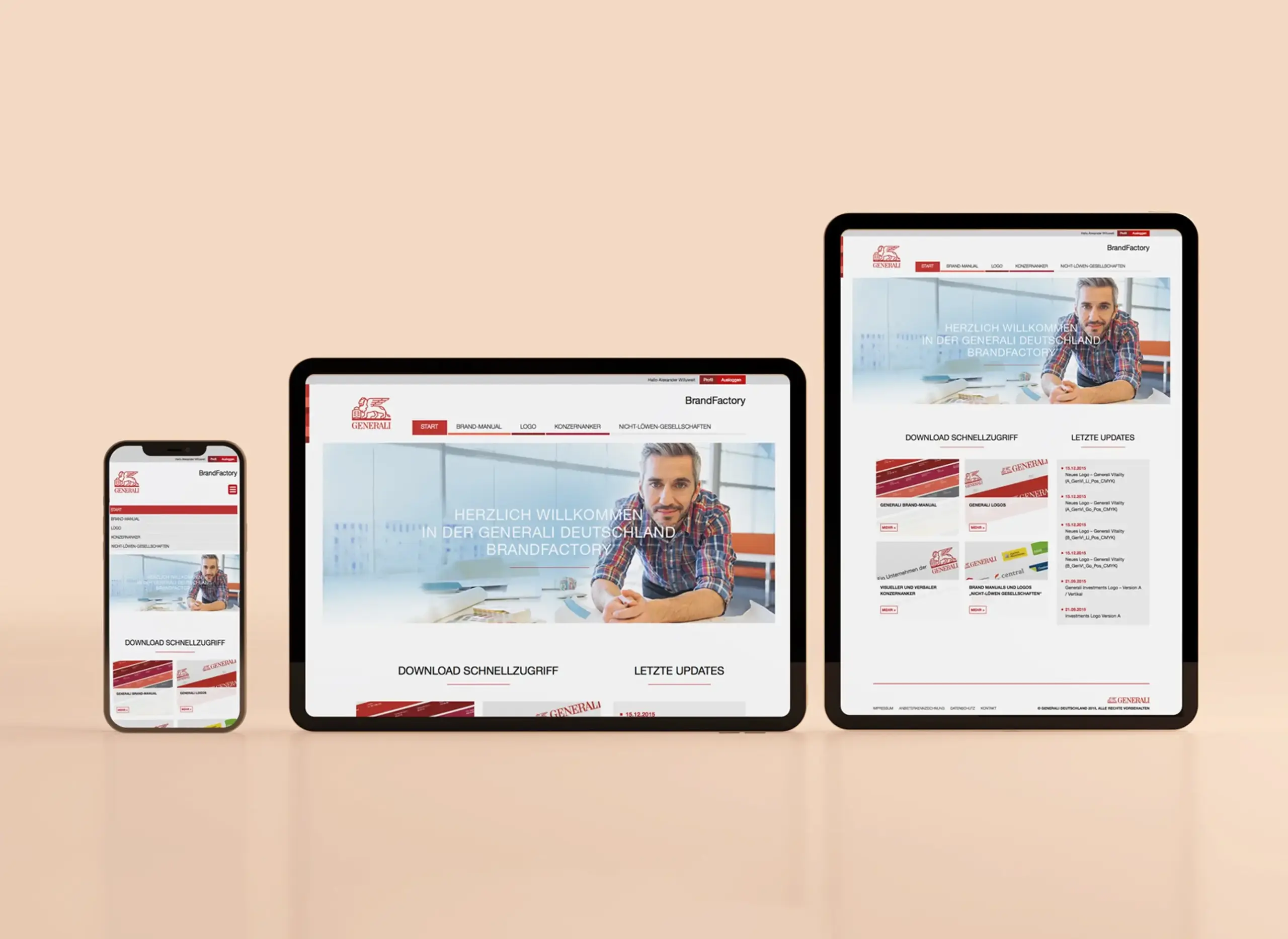
Generali — Brand management in a regulated environment..
Who this is for — and who it is not for
Right for you
- You manage a brand across multiple business units, locations or channels
- External partners, service providers or agencies work with your brand assets
- Your marketing team spends too much time on approvals and asset requests
- You have brand guidelines — but no system ensuring they are actually used
- You think in structures and want to anchor brand management sustainably within the organization
Not right for you
- You have one brand, one business unit and three employees — Dropbox is enough
- The portal is meant to be a storage space rather than a management system
- The budget is fixed, but processes and governance have not yet been considered
- You want to buy a standard solution quickly — not develop a system
Frequently asked questions
What is the difference between a brand portal and a DAM?
A DAM (Digital Asset Management system) is primarily a repository — structured, searchable, but passive. A brand portal, on the other hand, is a management system: it contains not only assets, but also rules, processes, access rights and governance. The key difference therefore lies not in the technology, but in the objective. While a DAM creates order, a brand portal creates independence — enabling everyone working with your brand to do the right thing without constantly needing to ask for approval. If an existing DAM system is already in place, we integrate it directly into the brand portal — keeping assets centrally managed while making them cleanly accessible through the portal.
Which technical platform do you use for brand portals?
As a brand portal agency, we deliberately do not tie ourselves to a specific platform. We develop custom web applications tailored precisely to the respective requirements — without license dependencies and with full control over future development and adaptations. If existing tools such as Frontify or Bynder are already in use or explicitly requested, we naturally integrate them as well. What we always bring to the table is the conceptual logic, the architecture and the content — because that is what truly makes a portal work.
Can other systems be connected to the brand portal?
Yes — and that is explicitly part of our approach. Brand portals rarely work in isolation. That is why, if desired, we connect existing systems such as DAM, PIM, CRM, intranet platforms or other software solutions. These integrations can happen directly at launch or be added later on — depending on the requirements. Because the portal is built as a system, such integrations can be implemented cleanly without destabilizing the overall structure.
Can we maintain the portal ourselves after handover?
Yes — and that is exactly the goal. That is why we build the portal in a way that allows teams to update content independently, add new assets and manage access rights themselves. Anyone who wants to involve us in the ongoing evolution of the portal can do so — but it is never a requirement.
Is there a single sign-on solution for the brand portal?
Yes — SSO can be integrated so users can log in with their existing company credentials. This significantly lowers the barrier for daily use and is especially important for larger organizations with many internal users, where adoption of the portal depends heavily on ease of access.
How long does it take to develop a brand portal?
That depends on the scope and complexity — usually between 3 and 6 months. A portal for a corporate group with 30+ sub-brands naturally requires more preparation than one for an organization with a clearly defined and already documented brand. The biggest factors are how well your existing corporate design is structured and how clearly the internal processes the portal is meant to support are already defined. We clarify all of this together in the first conversation.
Which automations are possible inside the brand portal?
The portal can do far more than simply provide content. If desired, we integrate automations that solve recurring tasks directly within the system — for example a logo generator that outputs on-brand assets in all required formats, or a presentation generator that automatically fills templates with content. This not only saves time, but also eliminates one of the most common sources of error in day-to-day brand management.
Can we track how the portal is being used?
We integrate analytics tools that show how the portal is actually being used: access rates, most frequently used areas, numbers of internal and external users, and download statistics. This not only creates transparency, but also provides the foundation for continuously improving the portal — based on real user behavior rather than assumptions.
When does a brand portal not make sense?
If the organization has one brand, one business unit and a small team, then a shared drive is often the more honest solution. A brand portal becomes valuable when many people, business units or external partners work with the brand — and when that currently creates too much coordination effort. If there is uncertainty, we assess together whether the need really exists. Even if the conclusion is that a brand portal is simply not the right solution yet.
Does this fit your situation?
Alexander Willuweit takes the time to clarify together whether a brand portal makes sense for your organization — and what the first meaningful step could be. No pitch. No pressure. Just an honest conversation.