Corporate Design Agency — Design as a System That Lives Within the Organization
When the corporate design exists — but only the agency knows how it works.
A corporate design (CD) that does not just look good — but continues to work over time. As a corporate design agency, we do not build visual appearances, but systems: for organizations that want to grow, lead and stay consistent.
What happens when there is no system behind it
The corporate design exists — but nobody can really work with it.
The guidelines exist as a PDF. Nobody really knows where it is. And nobody has the time to read it. So when someone quickly needs a presentation, they google the brand color or use whatever they can find. Not out of carelessness — but because the corporate design is not a system, only a document.
Every new touchpoint becomes a new project.
A new subpage, a new communication channel, a new medium — and suddenly the team is asking again: What would this look like within the corporate design? Systems provide answers. Documents, on the other hand, create questions.
The corporate design does not scale with the organization.
New business units, new markets, new partners — and suddenly there are twelve different versions of the brand. Not because nobody paid attention, but because the corporate design was never built to scale in the first place.
Relaunch instead of evolution.
Without a proper system, there is no real evolution — only repetition. When the foundation is not built systematically, the entire corporate design gets questioned again every three years. That costs time, budget and continuity.
What happens when there is no system behind it
The problem is the lack of a stable, scalable system that guides the brand.
How CRENEO develops corporate design: Not as a design assignment. At our agency, corporate design is part of a larger brand system built on four layers — core idea, rules, building blocks and application logic. Strategy, visual language and implementation form one connected system.
01
Analysis & System Diagnosis
Before we design, we define. Brand core, positioning and visual direction are not preliminary steps to design — they are its foundation. Anyone skipping this step builds on sand. That is why we first clarify: What is this brand really — and what should it communicate? Only then does the design process begin.
02
Strategy & Brand Architecture
A corporate design is only as strong as the structure behind it. That is why we never design before the architecture is clear — not as a rule of thumb, but as a principle. If the brand architecture is still unclear — whether parent brand, endorsed brand or house of brands — we solve that first. Because a corporate design built on unstable foundations will break again with the next stage of growth.
03
Design & System Development
Now we design. But not just colors and typography — a system. In practice, that means: a framework that works, design parameters that stay consistent across every application, and a corporate design that does not require explanation because it is logically constructed. This includes ready-to-use templates, importable color systems and prompts the team can apply immediately — including for AI-supported communication.
04
Handover & Implementation
At the end, the result is not just a file — but a system teams can manage independently. That is why we document carefully, train teams thoroughly and support implementation in a way that allows the corporate design to live inside the organization — instead of remaining on our hard drives.
05
Review & Evolution
A system is never a finished product. That is why, after handover, we continue reviewing together how the corporate design performs in practice — and optimize it for new requirements, new touchpoints and new technical possibilities. This keeps the brand not only consistent, but adaptable.
What changes — in practical terms
Without system thinking
- The corporate design lives in a file — not within the organization.
- Every new touchpoint becomes a new design project.
- The corporate design was created for print — and no longer works in digital channels.
- Guidelines exist — as a document nobody actually uses.
- The same project again in three years.
With the CRENEO system
- Jeder greift auf dieselbe Grundlage zu — automatisch.
- New touchpoints can be created without making new design decisions every time
- The brand scales without losing consistency
- The system explains itself — to everyone working with it
- The system is designed to handle new demands in branding, technology and touchpoints — both digital and physical — from the very beginning
Does that sound like the next step? Then let’s talk.
What changes inside the team tomorrow — when the corporate design becomes a system instead of a document
01
Marketing moves faster
Because the answers to design questions are already built into the system. New formats, new campaigns, new channels — instead of making new decisions every time, the team applies what already exists. That saves time while protecting consistency.
02
Teams become more confident
Modern corporate design systems are built to be simple enough for teams to create solutions quickly — while still maintaining a strong character anchor that secures a distinctive visual identity.
03
The brand stays consistent — even while growing
New locations, new business units, new markets: the system grows with the organization because it was designed for exactly that from the beginning. Consistency therefore becomes not an effort, but a natural result.
04
Creating media becomes faster and more efficient
Because the system takes over the work that previously had to be reinvented every time. Less coordination. Fewer corrections. Fewer questions for every new format. This is not a side effect — but a measurable result of systematic brand management.
Corporate design systems in practice
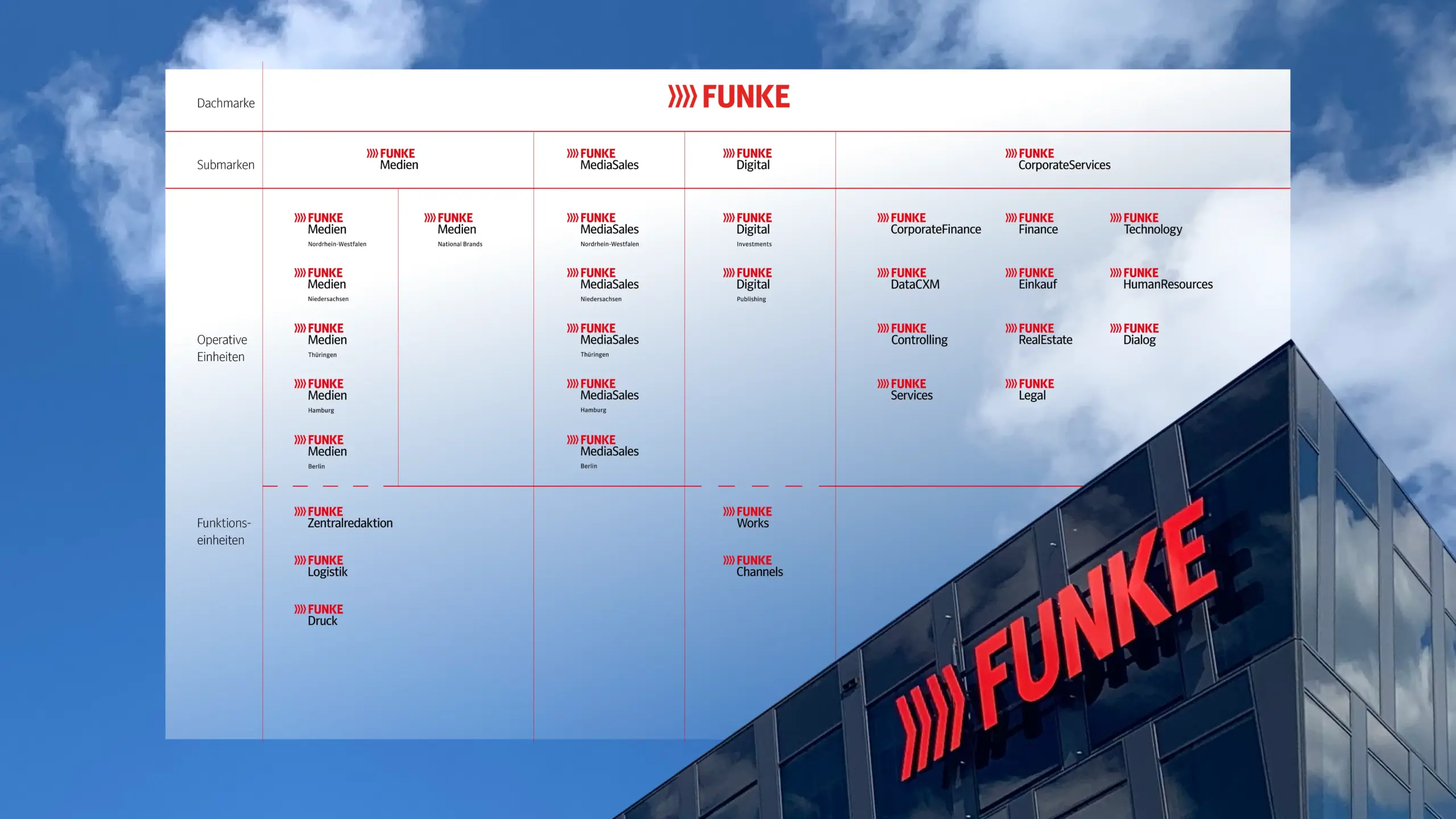
30+ sub-brands. One visual language.
FUNKE had developed many brands over the years — many business units, many voices, but no shared visual foundation. The request was: a new corporate design. The real challenge was: a brand architecture that creates unity without removing diversity.
As a corporate design agency, we did not just create a new visual identity for FUNKE — we developed a visual logic capable of supporting more than 30 sub-brands. The result is a corporate design system that stays flexible while remaining unmistakably FUNKE. Today, teams across all business units work with the same building blocks. The brand portal we developed in parallel makes the system usable for 6,000 employees every day.
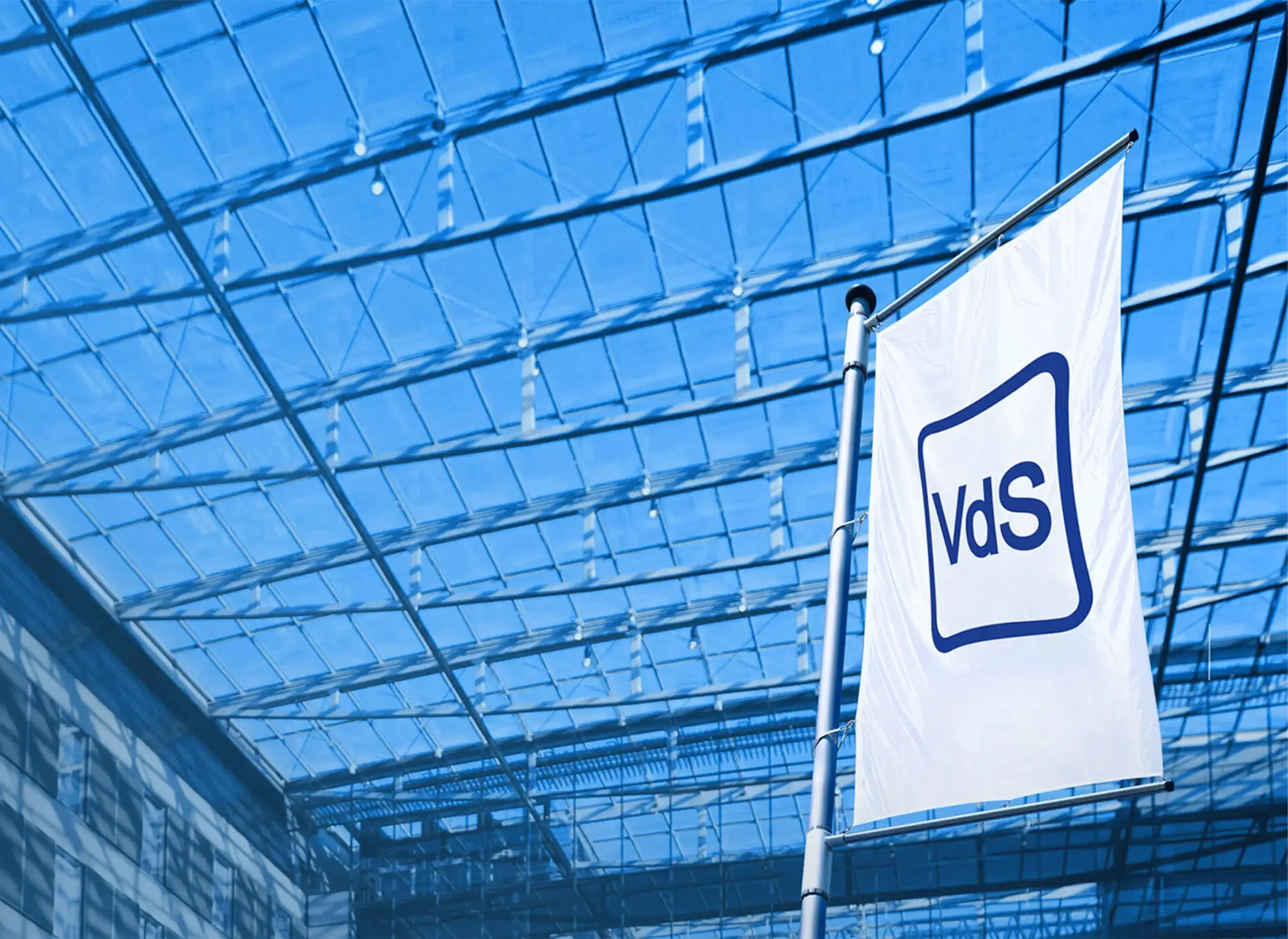
VdS Schadenverhütung — Structured. Flexible. Consistent.
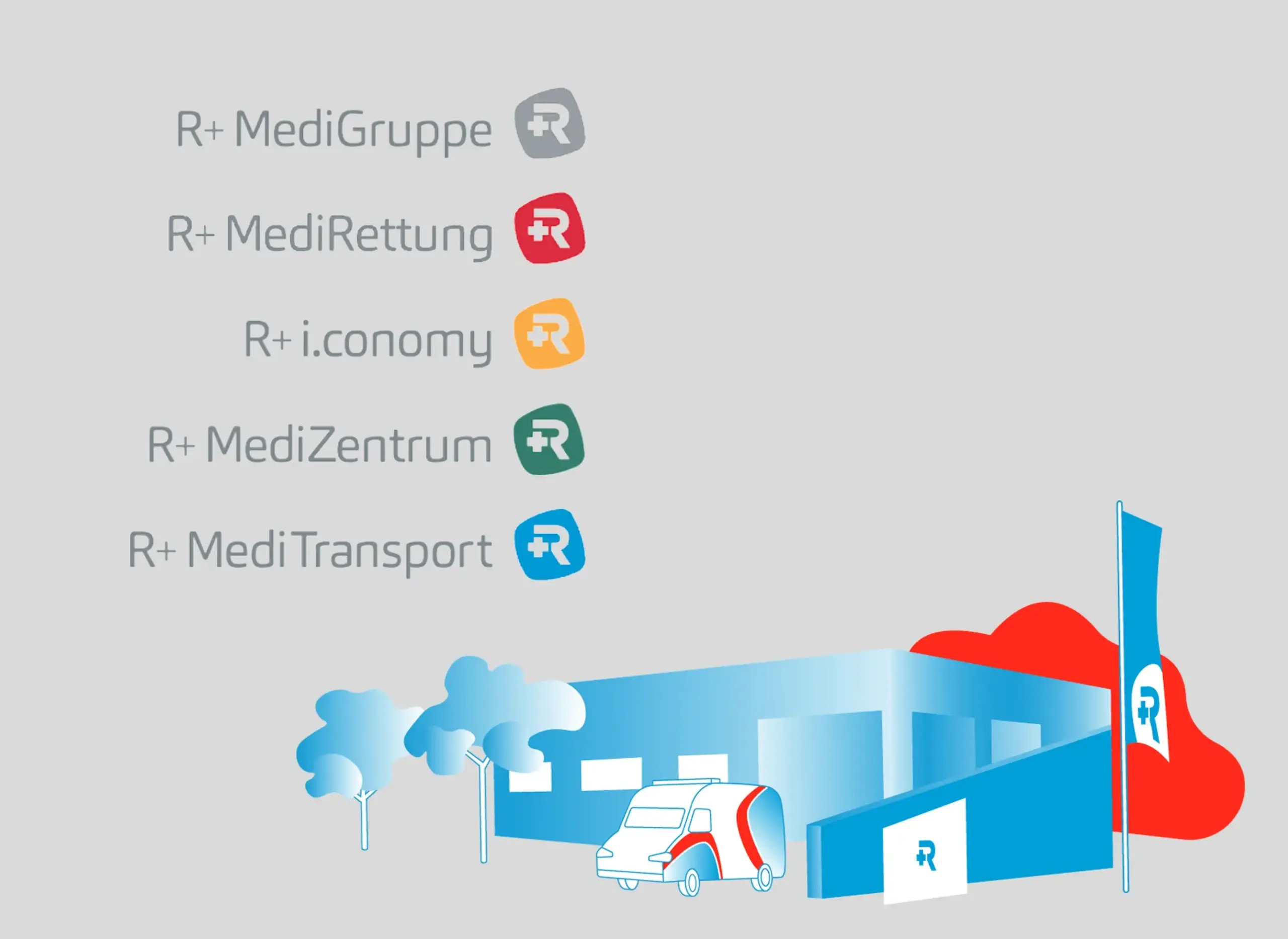
R+ MediGruppe — One system. From iconography to website.
Who this is for — and who it is not for
Right for you
- You notice that your corporate design no longer works across new channels or formats
- You are growing — new business units, new markets, new partners — but the brand is not keeping up
- External partners or internal teams are working with different versions of the brand
- You want a corporate design that lasts long term — not one that has to be redesigned every three years.
Not right for you
- You only want a new logo — without a system behind it
- The budget is fixed, but strategy and brand architecture have not yet been properly defined
- You need something fast, inexpensive and without intensive collaboration — in our view, that is not the right approach for your brand
- Your corporate design is solid, consistent and scales well — then this is probably not your next step
- You want many variations instead of clear decisions
Frequently asked questions
What is the difference between corporate design and corporate identity?
Corporate design is the visual part — colors, typography, layout systems and logos. Corporate identity is the bigger picture: how an organization understands, communicates and presents itself — visually, verbally and behaviorally. At CRENEO, we build both as a system, because one does not hold up without the other. A strong corporate design built on a weak identity foundation simply does not scale.
We already have a corporate design — do we need to start from scratch?
Not necessarily. We first look at what already exists and what is already working. Sometimes the existing corporate design is solid — what is missing is the system logic around it. In other cases, starting from scratch makes more sense. We clarify that together in the first conversation before recommending anything.
Do you also create individual design elements — logos, colors, typography — without the full system?
Not as an isolated project. The difference compared to question 2 is this: if an existing corporate design already functions as a system and individual elements need to evolve further, that is a different starting point — and yes, we do that. What we do not do: a logo without strategic context, colors without system logic or typography without a clear application framework. Because when individual elements are developed without considering the system behind them, the organization usually ends up facing the same project again three years later.
How long does it take to develop a corporate design with CRENEO?
That depends heavily on the scope. A focused project with a corporate design agency usually takes around 3 to 5 months for an organization. If brand architecture, implementation and a brand portal are added — which we often recommend — the process naturally takes longer. The biggest factor is how clearly the strategic foundation has already been defined. That is something we discuss in the first conversation.
Can we continue developing the corporate design ourselves after handover?
Yes — and that is exactly the goal. A corporate design that only works with us is not a system. That is why we document and structure everything in a way that allows teams to work with it independently afterwards. Anyone who wants to involve us in the ongoing development can do so — but it is never a requirement.
Does this fit your situation?
Alexander Willuweit will review together with you whether a corporate design project makes sense right now — and what the first meaningful step could be. No pitch. No pressure. Just an honest conversation.