
Corporate Design as a System — for everyone who works with it every day
Corporate design (CD) is more than a logo, colors, and typography. It’s the visual foundation on which a brand is run every day — across teams, locations, and channels. And that’s exactly where many fail: not in development, but in application. That’s why, at CRENEO, we develop corporate design as a system from the very start — with a guiding idea, clear rules, reusable building blocks, and a handover that truly empowers your team to work with it independently, without having to ask for approval on every decision.
What is corporate design?
Corporate design is an organization’s visual identity. It encompasses all the design elements a brand uses to present itself to the outside world: logo, colors, typography, imagery, iconography, and the rules that define how these elements work together.
It is part of corporate identity — the visual expression of what an organization stands for. And it is the foundation on which all further communication tools are built: website, presentations, campaigns, digital applications.
Why it often doesn’t deliver on its promise
Developing a corporate design is one thing. Making it work in the long run is another. The real problems rarely arise during development. They arise afterward — in the organization’s day-to-day operations.
Typical signs:
- The corporate design exists as a PDF but is barely used.
- Different teams, locations, or external service providers develop their own variants.
- There are too many design options and too few binding decisions.
- New employees don’t know what applies — and either keep asking or decide for themselves.
- AI-driven communication creates new variants because there’s no framework in place.
This isn’t a design problem. It’s a system problem. And it can be solved — if it’s conceived as a system from the outset.
How CRENEO develops corporate design
At CRENEO, creativity and system are not a contradiction. System is how creativity survives within organizations — across teams, locations, and channels.
That’s why we develop our projects on four levels:
1. Guiding idea
The brand’s core principle: a tone, a visual world, a formal language — recognizable across all channels. It emerges from the brand strategy and forms the basis for every design decision that follows.
2. Rules
What’s typical, what’s taboo. Clear decisions instead of 30 variants. Fixed in CD guidelines and corporate voice — so teams know what applies without having to ask every time.
3. Building blocks
Templates, modules, motion elements — reusable and built for everyday use. Not for the client presentation, but for the person who will work with it tomorrow.
4. Application
Website, brand portal, assets — implemented so the system still works after six months. When new employees join. When external service providers work with it. And even when the agency is no longer in the room.
The result isn’t a manual gathering dust on a shelf. It’s a foundation your team can build on independently — one your brand can grow with.
What corporate design at CRENEO includes
It’s always the interplay of all design decisions. No single element works on its own — only in combination does a brand emerge that is recognizable and can be managed with confidence.
- Logo system: Logo, variants, clear space, and application rules. Not just a mark — a system that works in every context.
- Color & typography: A defined color palette and type world that carries the brand’s character — and clearly establishes what’s possible and what isn’t.
- Imagery & iconography: A consistent visual language that holds up beyond individual campaigns and can be applied independently by teams.
- Layout principles: Grids, proportions, design rules — the foundation for all communication materials, digital and print.
- Motion principles: Movement as part of the brand language. How a brand behaves in digital contexts — consistently and recognizably.
- CD-Guidelines & Markenportal: The rules and building blocks that make corporate design accessible — not as a static document, but as a living resource teams use every day.
In practice
FUNKE Mediengruppe — Corporate design for 30+ sub-brands and 6,000 employees
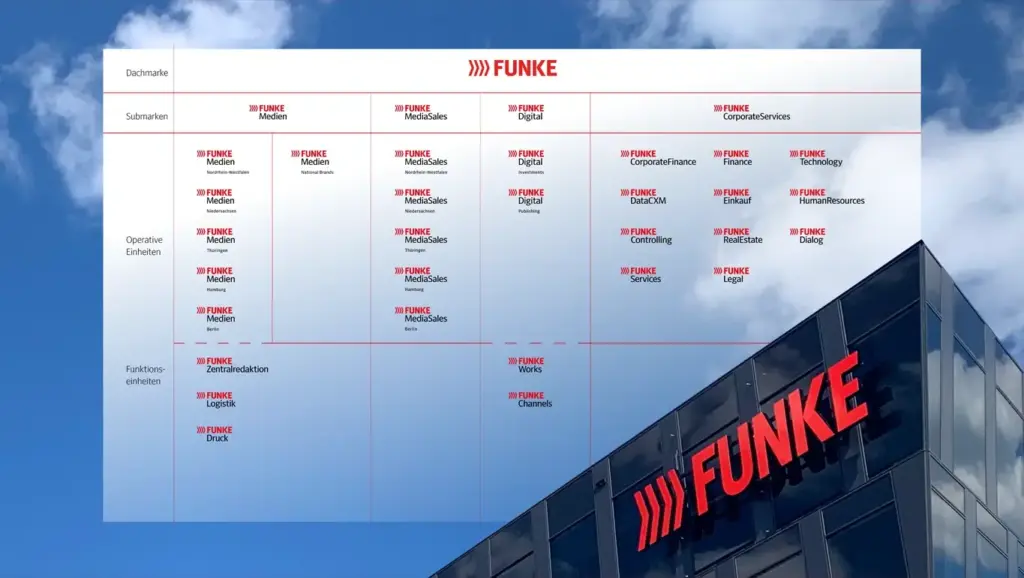
An inconsistent brand identity resulting from years of growth. Over 30 sub-brands, decentralized units, differing communication needs. CRENEO developed a brand architecture with a variable design — clear rules on what appears under which umbrella, which units are free to act independently, and which decisions are made centrally. The result: independent brand management across all units. View the FUNKE Mediengruppe case
VdS Schadenverhütung — Modular CD as a variable operating system
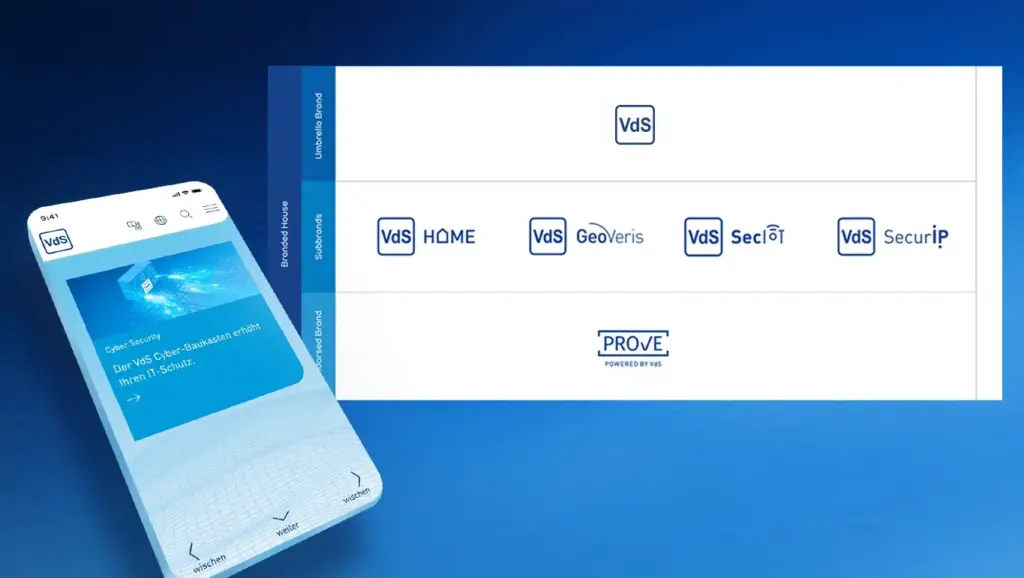
A corporate design for one of the most renowned institutions in corporate security. The requirement: versatile and easy to use — whether digital, print, motion, or spatial. CRENEO developed a modular design that makes clear decisions while remaining flexible enough to work across very different contexts. Strong proof that corporate design as a system doesn’t mean restriction — it means security. View the VdS Schadenverhütung case
Frequently asked questions
Corporate identity is the overarching term: it encompasses everything an organization uses to present itself, internally and externally — behavior, communication, language, and appearance. Corporate design is part of it: the visual expression of that identity. A strong corporate design only functions in the long run if it’s built on a clear corporate identity.
The cost of a corporate design depends on scope, complexity, and starting point. What matters isn’t just how many elements are developed, but whether the result can actually be applied within the organization. A corporate design that can’t be managed isn’t one — it’s a document. If you’d like to know what this means for your specific situation, talk to us directly.
A new corporate design makes sense when the brand no longer comes across consistently, when growth, a merger, or a reorganization has changed the starting situation, when a relaunch of the website or other touchpoints is coming up, or when the existing design no longer fits the strategy, target audience, or market position. Often the design itself isn’t the problem — the problem is that there’s no system behind it to ensure it’s applied consistently.
A corporate design system goes beyond individual design elements. It connects guiding idea, rules, building blocks, and applications so that teams across different units, locations, or channels can work with it independently and consistently — without having to rely on the agency for every decision. That’s the difference between a corporate design that looks good and one that actually works.
The duration depends on the starting point and scope. A corporate design built from the ground up — with a strategic foundation, a complete design system, and implementation — typically takes several months. If an existing corporate design is being further developed or systematized, the process can move significantly faster. Our brand system check is a compact first step for that.
Corporate design that actually works in your organization
A corporate design is only finished once your team can work with it independently — not once the last file has been handed over.
If you’re facing a relaunch, if an existing visual identity no longer works consistently, or if you want to roll out a brand across multiple units — that’s exactly the moment worth taking a closer look together.
Alexander Willuweit will take 30 minutes to understand your starting point and help find the most sensible next step together. No pitch. No pressure. A genuine conversation.